
Simulations suggest the Solar System may have lost two ice giants

The Solar System looks calm and well ordered today, with planets following stable, predictable paths around the Sun. But new research into one of the leading models of its early history suggests that this clockwork arrangement may have emerged from a far more chaotic past – and that we may once have had two additional ice giant planets.
A team led by astrophysicist Matthew Clement from Johns Hopkins University has tested how those missing worlds, proposed by the influential Nice model, would have shaped the fragile systems of moons around the giant planets. Their detailed simulations raise tough questions about whether the current version of the model can fully explain what we see today.
What the Nice model says about the early Solar System
The Nice model, first introduced in 2005 and refined since, was developed to explain several puzzling features of the outer Solar System. It proposes that the giant planets did not form where we see them now. Instead, they started out in a more compact configuration and gradually migrated through a disk of smaller icy bodies and debris.
In modern variants of the model, the early Solar System may have hosted one or even two extra ice giants in addition to Jupiter, Saturn, Uranus, and Neptune. As these massive planets interacted gravitationally with each other and with the debris disk, the system experienced a phase of intense dynamical instability. Some planets moved outward, others inward, and at least one or two ice giants were ultimately flung out of the Solar System entirely.
This scenario provides a good match to several large-scale features, such as:
- The current orbital spacing of the giant planets
- The Late Heavy Bombardment period, when impacts battered the inner planets
- The unusual population of Trojan asteroids trapped in Jupiter’s orbit
However, most previous tests of the Nice model have focused on this broad architecture. Clement and colleagues set out to see what such upheaval would do to a much more delicate structure: the regular moons of the giant planets, particularly around Uranus.
Putting Uranus and Jupiter’s moons into the model
The researchers built large suites of numerical simulations to probe how different versions of the Nice model would affect the satellite systems of Jupiter and Uranus. They explored a wide range of possible starting conditions for the outer Solar System, including scenarios with one or two additional ice giants.
In the simulations, the giant planets undergo close gravitational encounters during the instability phase. These encounters are exactly the kind of events required to scatter one or more ice giants out of the system and to rearrange the surviving planets into their current orbits.
The key question was: could such a violent phase occur without destroying or radically altering the orbits of the moons we see orbiting Jupiter and Uranus today?
A big problem for Uranus’s moons
Across most of the simulation runs, the answer for Uranus was no. The team found that the kind of close planetary encounters needed to eject extra ice giants almost always had severe consequences for Uranus’s satellites:
- Moons were driven into unstable orbits
- Some collided with each other or with their host planet
- Others were ejected entirely from the Uranian system
- Surviving moons often ended up on orbits quite different from the regular, near-equatorial paths we see today
Jupiter’s moons were more resilient in the simulations, but keeping both Jupiter’s and Uranus’s moon systems largely intact under the same evolutionary scenario turned out to be unusually difficult. Only one narrow class of simulations consistently preserved the regular satellites of both planets while still reproducing a Nice-style instability.
Three main interpretations of the results
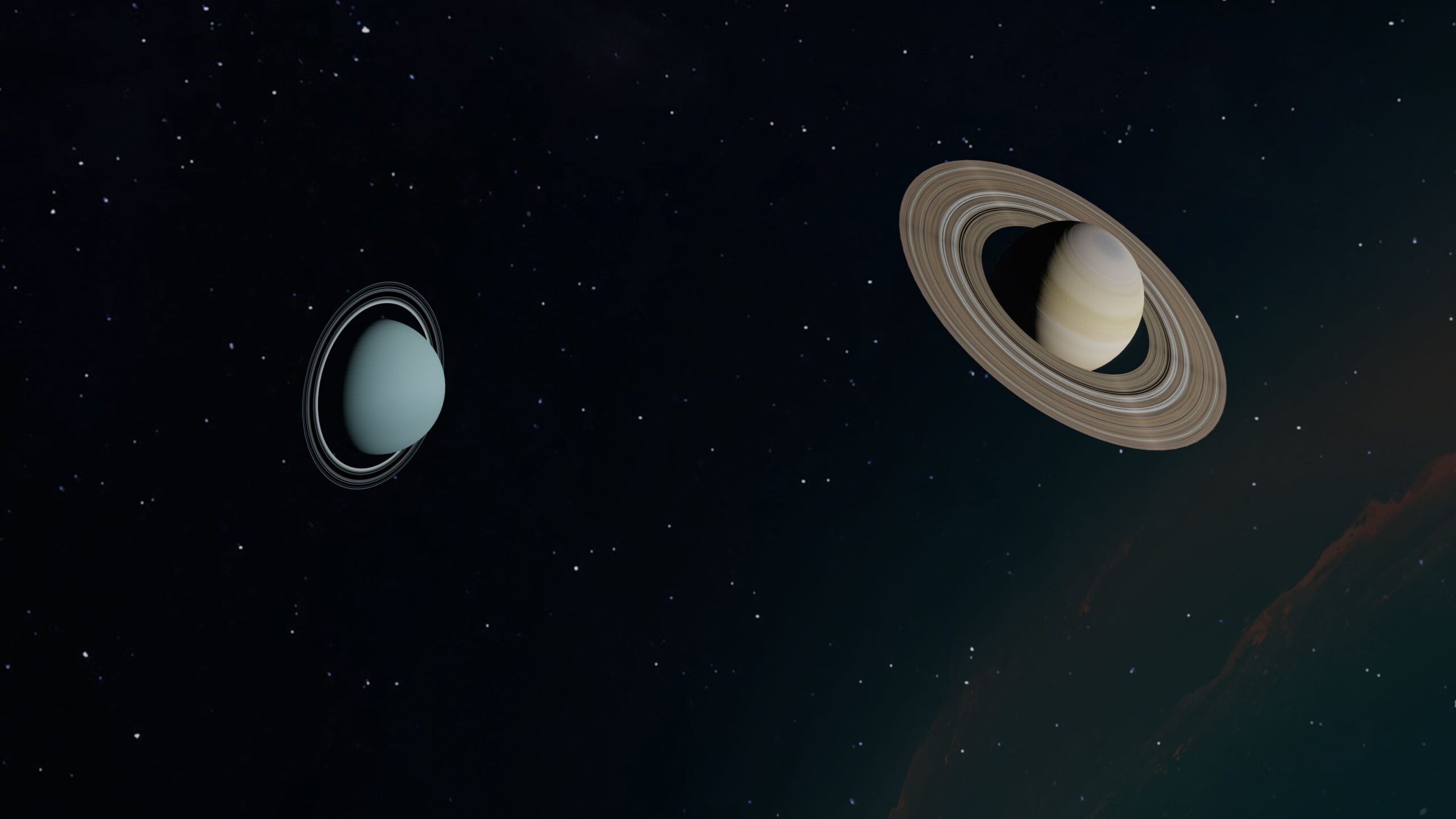
The study leaves several possibilities on the table for explaining how the present-day Solar System emerged:
- Multiple disruptions of the Uranian system. Uranus is already thought to have been tilted onto its side by a major impact early in its history. The new work suggests its moons may also have been reshaped by a later phase of planetary instability, involving collisions and re-assembly of the satellite system. In this view, Uranus’s current moons are survivors or products of at least two major disruptive events.
- The Nice model needs refinement. The findings indicate that the current formulations of the model may not capture the full range of possible evolutionary pathways, especially those that preserve regular moon systems. The real Solar System’s history might involve a subtler or more complex pattern of encounters than typically assumed.
- An improbable but not impossible history. It is also possible that the Solar System followed a relatively rare evolutionary track, in which the giant planets still went through instability and ice giant ejection, but did so in a way that largely spared the moons of Jupiter and Uranus from deep, disruptive encounters.
The researchers emphasize that no existing model is likely to reproduce every detail of the present Solar System, given that these events took place roughly 4 billion years ago and rely on incomplete information about initial conditions.
Why moon systems are such sensitive probes
Regular moons – those that orbit close to their planet’s equatorial plane on nearly circular paths – act as fragile record-keepers of their planet’s past. Because they are relatively low-mass and located near their host planet, they are highly sensitive to gravitational disturbances.
Uranus’s inner moons, for example, orbit on planes closely aligned with the planet’s extreme axial tilt. Their orderly configuration suggests they have not been repeatedly scattered or torn apart in the very recent past, at least not without leaving clear traces.
If the Nice-style instability was as violent and prolonged as many current versions suggest, the survival of such regular satellite systems becomes harder to explain. This is why Clement’s team argues that moon dynamics need to be treated as a key constraint, not a minor detail, when testing planetary migration models.
What comes next for Solar System evolution models
The new work does not rule out the Nice model, but it underscores that our picture of the early Solar System is still incomplete. Future studies will likely focus on:
- Exploring a wider range of instability strengths and timings
- Testing alternative patterns of planetary migration that limit close passes near Uranus
- Investigating scenarios where moon systems are partially destroyed and then reformed from collision debris
- Combining satellite-dynamics constraints with data from small-body populations, like Kuiper Belt objects and Trojan asteroids
As new observations from missions and telescopes, including the James Webb Space Telescope, continue to refine our understanding of the outer planets and their moons, models like Nice will be forced to adapt. For now, the fate of the Solar System’s possible lost ice giants – and the full story of how the current architecture emerged – remains an active and evolving mystery.
The study by Clement and his co-authors is published in the journal Icarus.


0 comments